Sleep on the Floor or in a Spaceship? The Guide to Ryokans vs. Capsule Hotels
You travel all the way to Japan. Why would you sleep in a hotel that looks exactly like the Marriott in Chicago?
Japan offers two sleeping experiences that are polar opposites, and as your friend, I think you should try both.
- The Ryokan: The ultimate traditional luxury (Sleeping on the floor).
- The Capsule Hotel: The ultimate futuristic efficiency (Sleeping in a pod).
Here is how to survive (and love) these unique accommodations.
1. The Ryokan (Traditional Inn): Travel Back in Time
A Ryokan isn’t just a place to sleep; it is a destination in itself. It is where you experience the soul of Japanese hospitality (Omotenashi).
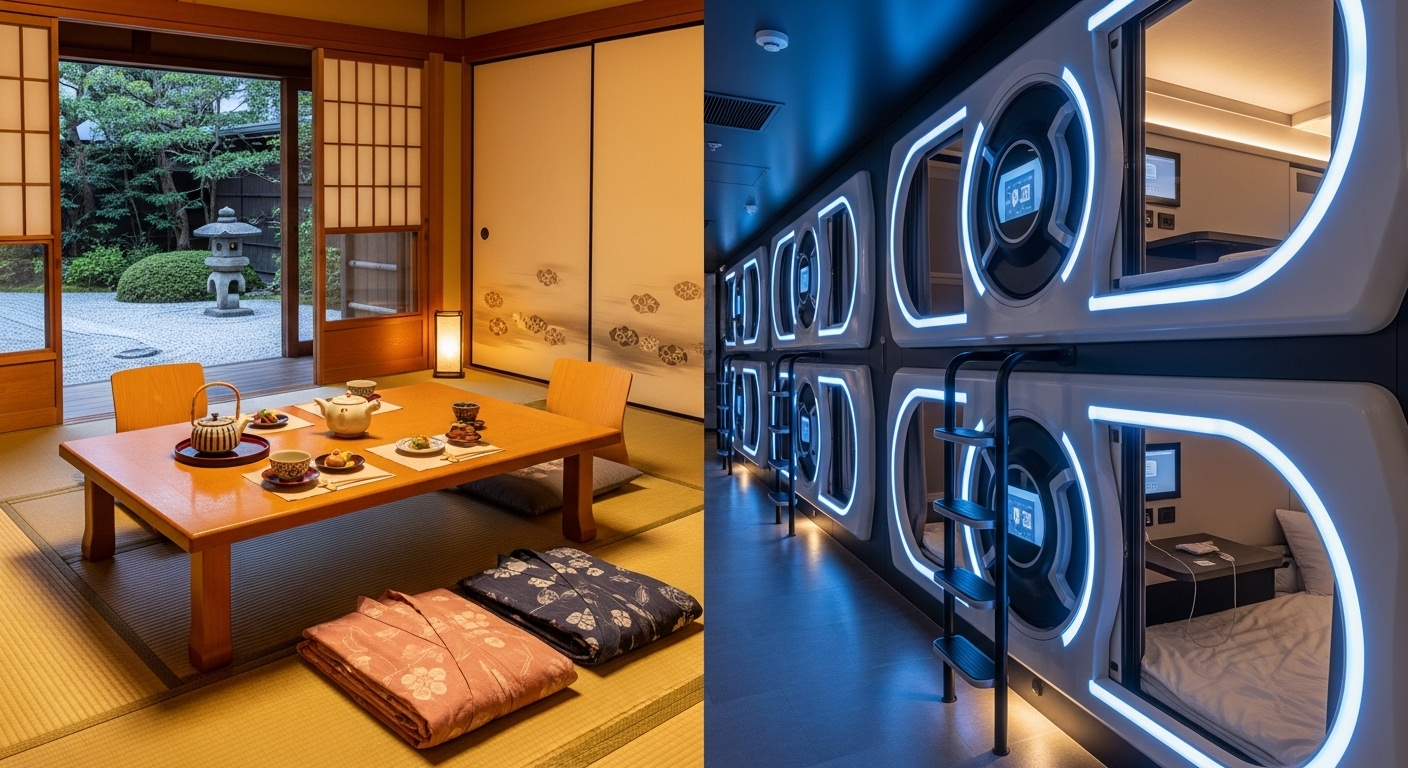
- The Room: No beds. You will find Tatami (straw mats) on the floor, a low table, and paper sliding doors (Shoji). It smells like grass and peace.
- The “Futon” Magic: You might wonder, “Where do I sleep?” Don’t worry. While you are eating dinner, the staff will magically enter your room and lay out fluffy Futons (mattresses) on the floor.
- Friend’s Note: Modern futons are very comfortable. Your back will be fine!
- The Food: This is the main event. Ryokans usually serve Kaiseki (a multi-course dinner) in your room or a private dining hall. It is a feast of local, seasonal ingredients.
- The Price: They charge “Per Person,” not per room. It is expensive ($150 – $500+ per person), but remember: it includes a massive dinner and breakfast.
- The Rule: You MUST take off your shoes at the entrance. You will wear a Yukata (cotton kimono) during your entire stay—even to dinner and outside for a walk!
2. The Capsule Hotel: Travel to the Future
Originally made for drunk businessmen who missed the last train, Capsule Hotels have evolved. Today, many are stylish, clean, and surprisingly cool.
- The “Pod”: It’s not a coffin. It’s a cozy, personal spaceship. It usually has lights, a fan, a USB charger, and sometimes a TV inside. You pull down a blind for privacy.
- The Locker System: You cannot bring your suitcase into the capsule. You leave big bags at the front desk and put your clothes/valuables in a locker.
- The Gender Rule: Most capsule hotels are separated by gender (Men’s floors and Women’s floors). This makes them very safe for solo female travelers.
- The Price: Cheap! ($25 – $50 per night).
- The Vibe: It is SILENT. Do not talk on the phone in the capsule area. It is for sleeping only.
- Friend’s Recommendation: Look for high-end chains like “9 Hours” (Nine Hours). They look like a sci-fi movie set.
3. The “Business Hotel” (The Tiny Savior)
If you don’t want the expense of a Ryokan or the tightness of a Capsule, there is a third option: The “Business Hotel.” (Chains like APA Hotel, Dormy Inn, Toyoko Inn).
- The Reality: The rooms are TINY. You might have to jump over your suitcase to get to the bed.
- The Perk: They are clean, private, affordable ($60-$100), and often have a great public bath (Onsen) on the top floor. Dormy Inn even gives you free Ramen at night!
4. A Quick Note on “Love Hotels”
You might see wild-looking hotels that look like castles or pirate ships. These are “Love Hotels.”
- What they are: Hotels for couples to have… “private time.” You can rent them for a “Rest” (2-3 hours) or a “Stay” (overnight).
- Should tourists use them? Actually… yes! They are often spacious, have huge Jacuzzis, karaoke machines, and are cheaper than regular hotels. Just be aware that the vibe is, well, romantic.
Summary: Your Accommodation Strategy
My advice for a 10-day trip? Mix it up.
- 7 Nights: Business Hotel (Convenient base in Tokyo/Osaka).
- 1 Night: Ryokan (Splurge in Hakone or Kyoto for the experience).
- 1 Night: Capsule Hotel (Just to say you did it—and save money).
Don’t just sleep. Make your accommodation a story to tell your friends back home.
Confused about how to book a Ryokan (many websites are Japanese only)? Ask us. We can recommend the most foreigner-friendly Ryokans that offer the best Kaiseki dinners without the language barrier.