Shrine or Temple? A (Very) Simple Guide to Not Being Confused in Japan
You’ve arrived in Japan. You’re ready to see some beautiful, historic sites.
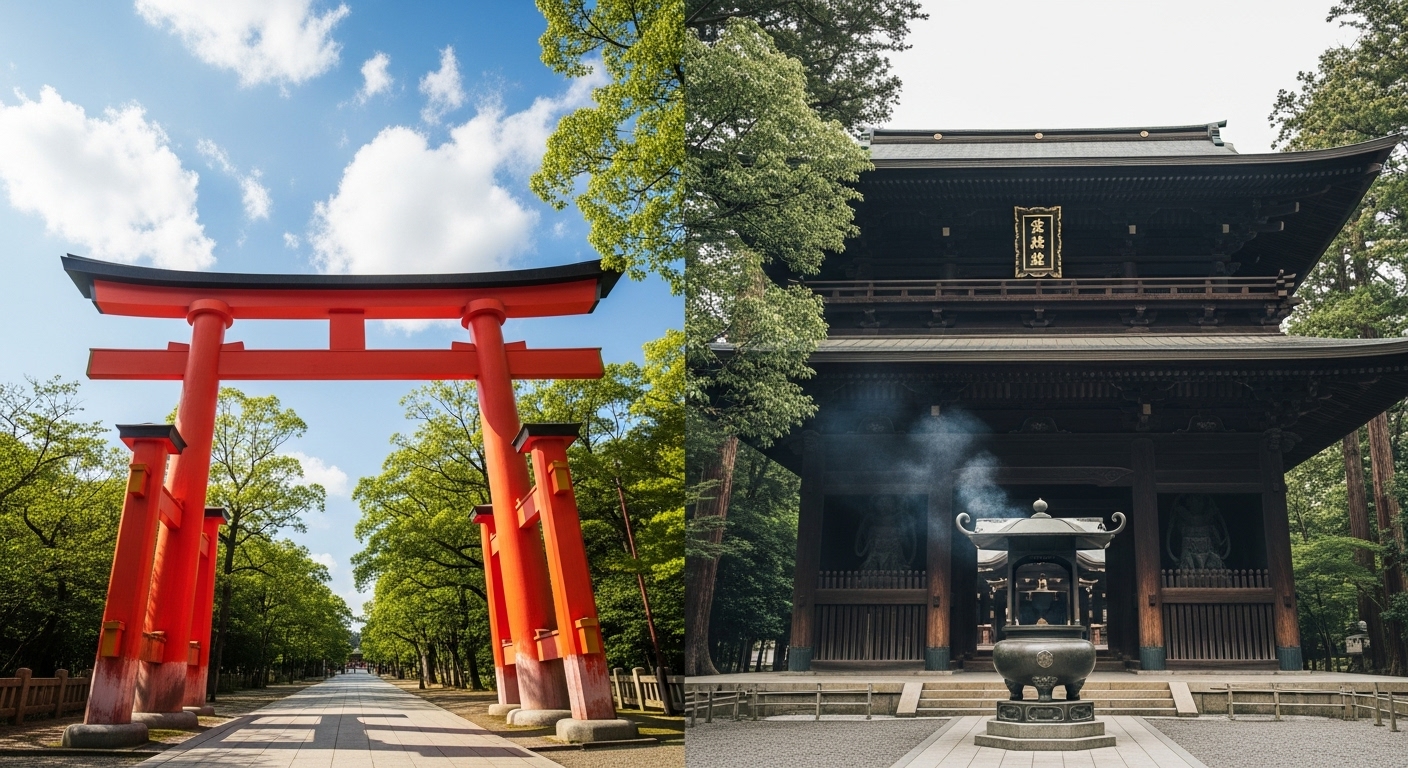
You walk up to one… it has a huge, simple, red gate (a Torii).
You walk up to another… it has a massive, ornate wooden gate with statues and a giant incense burner.
Wait… why are they different? Are they both temples?
Welcome to Japan’s #1 most confusing (but fascinating) cultural question! As your friend, let me clear this up for you in the simplest way possible.
The 2-Second Difference: Who Are You Visiting?
Here’s the only difference you really need to know:
- SHRINE (神社, Jinja)
- Religion: Shinto (Japan’s native religion).
- Who’s “home”: The Kami (gods or spirits of nature, ancestors, etc.).
- How to spot: Look for the Torii Gate (usually red, but sometimes wood or stone). This marks the entrance to a god’s “home.”
- Example: Meiji Jingu (Tokyo), Fushimi Inari (Kyoto).
- TEMPLE (お寺, O-tera)
- Religion: Buddhism (imported from India, via China/Korea).
- Who’s “home”: The Buddha and various Bodhisattvas (enlightened beings).
- How to spot: Look for a large Sanmon Gate (a big, building-like gate, often with a roof) and a large incense burner. You’ll also see lots of Buddhist statues.
- Example: Senso-ji (Tokyo), Kiyomizu-dera (Kyoto).
That’s it! Shinto = Kami (Gods) & Torii gates. Buddhism = Buddha & Incense.
How to Be Respectful (The Simple, Stress-Free Way)
You don’t need to be a theologian. Being respectful is easy and locals love when you try. Here’s your “Best Friend’s” cheat sheet.
At a SHRINE (Visiting the Kami):
- The Torii Gate: Bow once before you walk through. You’re entering a sacred space. (Friend’s tip: Try to walk slightly to the side, not the dead center, as the center is for the Kami).
- Purification (The Water Fountain): You’ll see a water station called a temizuya. This is NOT for drinking.
- Take the ladle with your right hand, scoop water.
- Pour some on your left hand.
- Switch hands, pour on your right hand.
- (Optional pro-move) Pour a little water into your cupped left hand and rinse your mouth. Spit it on the ground beside the trough, not back into it.
- Hold the ladle upright so the remaining water cleans the handle.
- Praying (The “Clap-Clap” Method):
- Walk up to the main hall (there’s usually a large offering box).
- Gently toss a coin in (5 yen is lucky!).
- Bow twice.
- Clap your hands twice. (This gets the Kami‘s attention).
- Make your wish in your heart.
- Bow one last time.
At a TEMPLE (Visiting the Buddha):
- The Main Gate: Walk through. You can put your hands together (gassho) and bow if you like, but it’s not as strict as a shrine.
- The Incense (O-koro): You’ll smell it. Many people buy a bundle of incense (osenko), light it, and place it in the giant burner.
- Friend’s Tip: After placing your incense, waft some of the smoke towards you. It’s believed to have healing properties. Waft it onto your head (for wisdom), shoulder (for aches), etc. It’s a fun ritual.
- Praying (The “Silent” Method):
- Walk up to the main hall.
- Toss a coin in the offering box.
- Gently put your hands together.
- Bow your head and make your wish silently.
- DO NOT CLAP. (Buddha is right there; you don’t need to get his attention).
- Bow again when you’re finished.
Your Final Cheat Sheet
| Feature | SHRINE (Shinto) | TEMPLE (Buddhism) |
| Who’s Home? | Kami (Gods/Spirits) | Buddha |
| Entrance | Torii Gate (Simple gate) | Sanmon Gate (Building gate) |
| Key Feature | Water purification | Incense burner |
| How to Pray | Bow, CLAP, CLAP, Bow | Bow, Silent wish, Bow |
See? Not so scary.
The most important rule is just to be quiet, be respectful, and enjoy the beautiful, peaceful atmosphere.
And hey, if you forget this entire guide, don’t worry. Just watch what the locals do and follow their lead.
Or, even better, join one of our tours. We can walk you through it in person and tell you the fascinating stories behind these rituals—which is way more fun than just reading a list.